

| Motorola Mobility Confidential Restricted. | ||||||||||||||||||||||||||||||||||||||||||||||||||||||||||||||||||||||||||||||||||||||||||||||||||||||||||||||||||||||||||||||||||||||||||||||||||||||||||||||||||||||||||||||||||||||||||||||||||||||||||||||||||||||||||||||||||||||||||||||||||||||||||||||||||||||||||
|
ToiApplicationService Interface Reference DescriptionThe Application Service is responsible for maintaining the lifecycles of every application registered in the system.
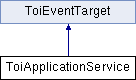
Inheritance diagram for ToiApplicationService:
Member Typedef Documentation
The application identifier type.
A sequence of application identifiers.
A sequence of application info structure.
The ToiApplicationService::TToiApplicationState datatype enumerates the different states an application can be in. The application process (or processes) may exist in the system only when in ToiApplicationService::STATE_STARTING, ToiApplicationService::STATE_INVISIBLE, ToiApplicationService::STATE_VISIBLE or ToiApplicationService::STATE_ACTIVE states. This means that it is guaranteed that the application has exited before it enters ToiApplicationService::STATE_STOPPED.
A sequence of property string values. Member Function Documentation
This method changes the state of the given application to ToiApplicationService::STATE_ACTIVE. The currently active application will become visible or invisible and if there is an application that is visible it might become invisible.
This method does the same thing as ToiApplicationService::activate() but it also tells the newly activated application to execute a command.
This method does the same thing as ToiApplicationService::activate() but it also tells the newly activated application to load a specific URI.
This method changes the state of the given application to ToiApplicationService::STATE_INVISIBLE IF it can be determined which application should become active. If it cannot be determined which application should become active, ToiApplicationService::deactivate() does not change state of any application. Use this method to make popup applications disappear.
Returns the identifiers for all registered applications.
Returns the value of a boolean property for an application.
Returns information about the application.
Returns the value of an integer property for an application.
Returns the calling application's identifier. This function is mainly intended for Javascript since the identifier is also available in the APPLICATION_ID environment variable.
Returns the value of a string property for an application.
Returns the values of a sequence property for an application. Unlike the other property functions it does not throw an exception if the property does not exist, instead it returns an empty sequence.
Kill an application. This method has no effect if the application is not currently running. If the application is running it will be restarted automatically if the restart property is true. This method is useful in forcing an application to a known initial state.
Call this method to tell the Application Service to load a specific URI. If an application is registered to handle the type of URI, it will be activated and (C++) ToiApplication::LoadUri() will be called.
Member Data Documentation
This is an Event identifier for ToiApplicationStateChangedEvent. This constant can also be accessed from toi.consts.ToiApplicationService.ON_STATE_CHANGED. In ToiApplicationService::STATE_ACTIVE, the application is running and is the frontmost one visible to the user and receiving all user input. This constant can also be accessed from toi.consts.ToiApplicationService.STATE_ACTIVE. In the ToiApplicationService::STATE_INSTALLED state, the application is installed on the system, ready to be started. The application may enter this state from ToiApplicationService::STATE_INSTALLING or ToiApplicationService::STATE_STOPPED. The application leaves this state either by being started (entering STATE_STARTING) or by being uninstalled (entering ToiApplicationService::STATE_REGISTERED). This constant can also be accessed from toi.consts.ToiApplicationService.STATE_INSTALLED. In ToiApplicationService::STATE_INSTALLING, the application's installation package and packages needed by the installation package are being installed. The application enters this state from ToiApplicationService::STATE_REGISTERED. If the installation was successful the application enters ToiApplicationService::STATE_INSTALLED. If the installation failed the application enters ToiApplicationService::STATE_REGISTERED again. This constant can also be accessed from toi.consts.ToiApplicationService.STATE_INSTALLING. In ToiApplicationService::STATE_INVISIBLE, the application is running but it is not visible to the user. In this state the application should preserve computing resources by not doing anything that has the sole purpose of producing output to the screen. This constant can also be accessed from toi.consts.ToiApplicationService.STATE_INVISIBLE. In ToiApplicationService::STATE_REGISTERED, the application exists only as a simple registration entry containing the basic application properties. This constant can also be accessed from toi.consts.ToiApplicationService.STATE_REGISTERED. During ToiApplicationService::STATE_STARTING, the application will be started and it will initialize itself to become fully operational. The application leaves this state for one of the running states by registering with the Application Service, using the (C++) ToiApplicationService::ReportStarted() method. Which one of the running states ToiApplicationService::STATE_INVISIBLE, ToiApplicationService::STATE_VISIBLE, or ToiApplicationService::STATE_ACTIVE, it enters basically depends on the states of other applications running on the system. If the application fails to register with the Application Service within a configurable time, the application will be stopped.
This constant can also be accessed from toi.consts.ToiApplicationService.STATE_STARTING. In ToiApplicationService::STATE_STOPPED, the application process (or processes) does no longer exist in the system. The application may get to this state either by exiting in an orderly fashion, crashing, misbehaving in such a way that the Application Service decides to stop it. When the platform has released all resources and there are no references left to the application instance the application will leave ToiApplicationService::STATE_STOPPED. Depending on if the application is configured to restart automatically or not, or if the application should be uninstalled, it will enter ToiApplicationService::STATE_STARTING or ToiApplicationService::STATE_INSTALLED. This constant can also be accessed from toi.consts.ToiApplicationService.STATE_STOPPED. In ToiApplicationService::STATE_VISIBLE, the application is running and is visible (partly or complete) to the user, but does not receive any user input. This constant can also be accessed from toi.consts.ToiApplicationService.STATE_VISIBLE. |
||||||||||||||||||||||||||||||||||||||||||||||||||||||||||||||||||||||||||||||||||||||||||||||||||||||||||||||||||||||||||||||||||||||||||||||||||||||||||||||||||||||||||||||||||||||||||||||||||||||||||||||||||||||||||||||||||||||||||||||||||||||||||||||||||||||||||