| ARRIS Enterprises, Inc. Confidential Information |
KreaTV TV Software ArchitectureOverviewKreaTV is a lightweight architecture defining an application platform (framework) for Multimedia IP Set-Top Boxes, e.g. the KreaTV IP-STB series. The architecture is designed for a hardware environment with very limited resources (memory and CPU). It is also designed for a specific user environment (the TV environment) and specific applications (viewing broadcast television, video on demand, music, e-mail and chat, etc). The KreaTV Platform, referred to as 'the platform' hereafter, offers a variety of services to the running applications. These services allow easy access to the IP-STB's hardware resources, as well as provide functionality common to applications within the TV-viewing environment. In short, the platform...
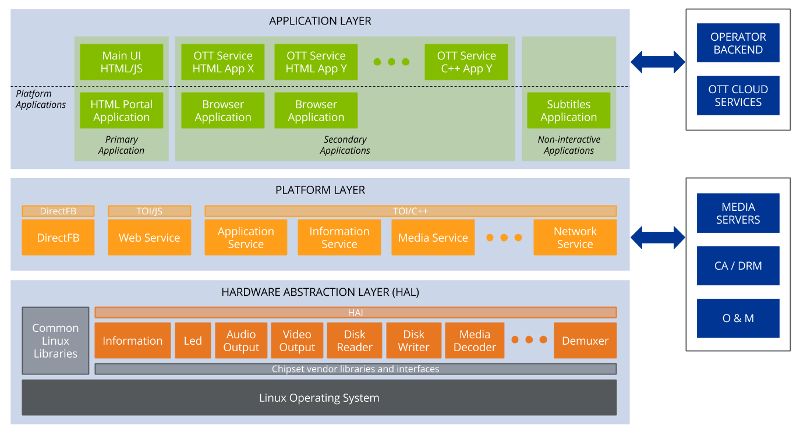
The figure above shows an overview of the most central parts of the architecture. At the lowest level, an abstraction layer isolates and hides hardware differences between the different IP-STB models, presenting a common interface to the layers above. The IP-STB's run a linux operating system. The KreaTV platform provides running applications with various services. Each service provides one or more interfaces through which the interaction with the application is handled. As an example, the Media Service handles the playing of TV streams. The application tells the Media Service which URL should be opened and played, and the Media Service does the rest. A Profiler Service allows for measuring various performance related characteristics, and so on. The total set of service interfaces is named the TV Open Interface (TOI). TOI exists on different levels but is primarily aimed at being used from a browser via JavaScript. See the multiapplication terminology page
for more information on applications in KreaTV 5.
Input HandlingThe KreaTV IP-STB software supports input handling through standardized JavaScript DOM level 3 event model. See the input introduction page for more information. Fault toleranceAs shown in the figure below the architecture is layered. Each layer implements a strategy for handling errors in the layer above. When an erroneous application or service is detected the layer below takes an action to solve the problem with minimal user impact as described below:
|